Category Archives: DAILY LIFE

magbo system

Everything We Need, Part Two

Review of Part One: In Part One, we looked at the first three verses of the first chapter of Second Peter. We learned that, through having a personal relationship with Jesus, God has already provided everything we need for life and for that life to be godly. In Part Two, we see how He does that and how we are to respond.

His exceedingly great promises.  First, go back and re-read the first three verses of 2 Peter chapter one. Then read verse 4:

(4) By means of these He has bestowed on us His precious and exceedingly great promises, so that through them you may escape (by flight) from the moral decay (rottenness and corruption) that is in the world because of covetousness (lust and greed) and become sharers (partakers) of the divine nature. (AMPC)”

In this verse Peter tells us that the cause of the moral decay filling the world is lust and greed. However, we can flee away from that and share in God’s divine nature through the fulfillment of God’s promises in our lives. God has given us His very great promises because of His glory and His goodness. Look closely at the first three phrases in the next verse, verse 5.

(v. 5) For this very reason, adding your diligence [to the divine promises], employ every effort in exercising your faith to develop. . . 

That phrase “For this very reason” points back to verse 4. Peter says that because of the great promises God has given us, we must make every effort, which means be diligent, to add godly qualities to our faith. Then Peter lists seven qualities that we can – and are supposed to — develop in ourselves. We develop these by God’s grace of course, but it requires our effort or it will not happen.

To reiterate, Peter says God has given us all that we need to live a godly life and the way to live that godly life is to flee the world’s corruption by participating in the nature of God. We do that by diligently exercising our faith and continually growing in Jesus, which means developing godly qualities.

What qualities should we pursue? Verses 5 through 7 list the godly qualities Peter says we can develop. We are to add to our faith: virtue, knowledge, self-control, perseverance, godliness, mutual affection, and love. Putting each phrase on a separate line makes the process of how to acquire these qualities easier to see.

 “For this very reason, adding your diligence [to the divine promises], employ every effort

  • in exercising your faith to develop virtue (excellence, resolution, Christian energy),
  • and in [exercising] virtue [develop] knowledge (intelligence),
  • And in [exercising] knowledge [develop] self-control,
  • and in [exercising] self-control [develop] steadfastness (patience, endurance),
  • and in [exercising] steadfastness [develop] godliness (piety),
  • And in [exercising] godliness [develop] brotherly affection,
  • and in [exercising] brotherly affection [develop] Christian love.”

 The process of developing godly qualities. Do you see the pattern? As we exercise, or use, one quality, we develop another godly quality, another attribute of the divine nature. “In exercising _________ develop ________.”

When we obey God and exercise, or use, the small bit of spiritual muscle we have, God develops that muscle. As that particular spiritual muscle develops—in response to our using it–the spiritual muscles and tendons around it also grow and another good quality starts to grow. And on and gloriously on!

A good comparison is physical exercise. Let’s say I’m a high school gym student. The coach says he is sure I have potential as a distance runner. I have faith in him, so I add to my faith in what the coach told me by starting with what I have. I diligently, industriously, start running every day. As I continue exercising my faith in what the coach told me, I develop strength, in general, in several body systems and muscles. As I continue running daily, my legs become stronger. I see (or the coach tells me) I must also do strength training to develop my quadriceps muscles so my knees will stay strong. I do that and next the coach assigns exercises to strengthen my hips and on and on until I have a well-trained runner’s physique.

Or consider someone who wants to have strong arms. I start with biceps exercises and those biceps muscles grow as I diligently work out, week by week. While I am developing my biceps, the triceps are also affected. Next I add triceps exercises. Next come the shoulders. And on and on until all muscle groups are strong.

Why do we need to develop these godly qualities? The answer is simple: these qualities will keep us from being idle or unfruitful, both of which are dangerous spiritual conditions. Look at verse 8.

(8) For as these qualities are yours and increasingly abound in you, they will keep [you] from being idle or unfruitful unto the [full personal] knowledge of our Lord Jesus Christ (the Messiah, the Anointed One).


Notice we must develop these godly qualities and then keep on developing them. These qualities must “increasingly abound.” God puts a stern warning in Verse 9 for those who do not keep growing.

(v. 9) For whoever lacks these qualities is blind [spiritually shortsighted] seeing only what is near to him and has become oblivious [to the fact that] he was cleansed from his old sins.”

Do you remember how many times in the Old Testament God had to punish the Israelites because they lost sight of what He had done for them, could not see clearly Who He was and turned to their old ways of living?

Remember that God has already made the way for each of us to develop these qualities. God equips us for everything we need to live a godly life. If we fail to develop spiritually, we harm ourselves. Greatly. We remain spiritual infants, weak creatures and easy prey for the enemy of our souls. Our spiritual infancy requires that someone else carry us, feed us, and put up with our immature behavior.

Do you want to avoid stumbling and falling?  God gives us a priceless promise in verse 10. He says if we work diligently to develop those godly qualities, we will never stumble or fall.

(v. 10)  “Because of this, brethren, be all the more solicitous and eager to make sure (to ratify, to strengthen, to make steadfast) your calling and election; for if you do this, you will never stumble or fall” (emphasis added).  (The NLT says “fall away.”)

That “because of this” at the start of verse 10 connects this verse to those that came before. Because of the great potential that awaits us in God’s promises, we should be eager to do what God says and work diligently to develop God-like qualities. God does not promise a life free of problems, in fact Jesus says quite the opposite in John 16:33. However, God does promise we will be able to keep walking safely with Him. And it will be with joy and all the other results of having an intimate relationship with Jesus (Galations 5:22-23).

(v 11.) “Thus there will be richly and abundantly provided for you entry into the eternal kingdom of our Lord and Savior Jesus Christ.”

The Enduring Word Commentary has this note about 2 Peter 1:11: “Peter here reminded his readers of the great reward of a calling and election made sure. They would enter heaven gloriously, not as through fire (1 Corinthians 3:15.)”  Read 1 Corinthians 3:10-15 and meditate on that warning.

Be stirred up. Friend, may we be reminded about these things and stirred up “by way of remembrance”, as Peter wanted us to be. Peter said, “I think it right, as long as I am in this tabernacle (tent, body) to stir you up by way of remembrance.” (2 Peter 1:12, AMPC).  May we diligently exercise our faith so we may become strong and develop every godly quality.

Godly qualities will save us from the darkness of our present world. And we will shine like stars in that darkness. As the apostle Paul says in Philippians 2:14-16:

Do all things without grumbling and faultfinding and complaining [against God] and questioning and doubting [among yourselves].

That you may show yourselves to be blameless and guileless, innocent and uncontaminated, children of God without blemish (fault-less, unrebukable) in the midst of a crooked and wicked generation [spiritually perverted and perverse], among whom you are seen as bright lights (stars or beacons shining out clearly) in the [dark] world. ( AMPC)
Everything we need

“His divine power has given us everything we need for life and godliness through our knowledge of Him Who called us by His own glory and goodness.” (2 Peter 1:3, NIV, 1984)

3 For His divine power has bestowed upon us all things that [are requisite and suited] to life and godliness, through the [full, personal] knowledge of Him Who called us by and to His own glory and excellence (virtue).  (2 Peter 1:3, AMPC)

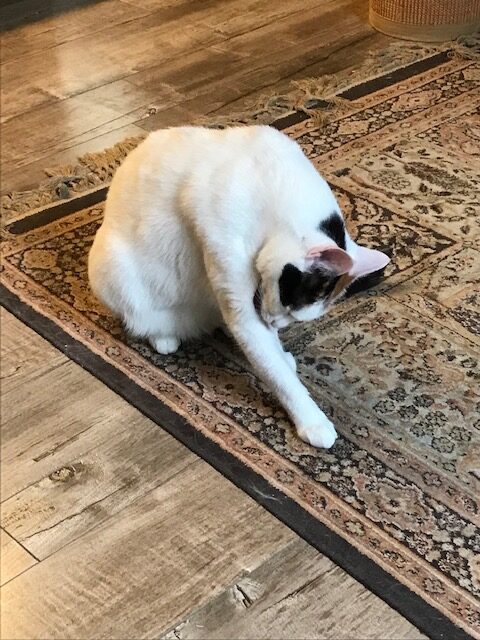
We already have everything we need for. . . . I watched Lily closely. She had just started her morning catly ablutions, thoroughly licking one slender paw, rubbing it over and over the right side of her face, then more licking and more rubbing until that side of her face was satisfactory, then repeating the process on the left. Next came her shoulders, then tummy which required an awkward posture and finally her hind parts, rear leg straight up in the air in the most undignified way.

“Hmmm, Lord,” I reflected, “You have given my little Lily and all cats everything they need for life, everything they need to take care of themselves. Either their mother, instincts or both teach them to keep themselves clean, to hunt and eat food, to socialize, to reproduce and to raise their young. I know that their grooming keeps their coat healthy by distributing oils, removes dirt and pests, calms them down and, if necessary, cools them. You’ve given them everything they need for life . . . ”

I paused a beat, then smiled.

“. . . just like You have given us everything we need for life and godliness through Your very great and precious promises. Let me see, where was that verse? I still remember the jolt of power in those words the first time I understood them. . .”

“His divine power has given us everything we need for life and godliness through our knowledge of Him Who called us by His own glory and goodness.” (2 Peter 1:3, NIV, 1984)

Background of our text: First Peter was written by Peter, one of the disciples of Jesus, to a group of Christians who were being persecuted for their faith. Peter urged them to remember what Jesus did for them and he encouraged them to live holy lives. He gave instructions for living a holy life in a sinful world. Second Peter was written to the same group of Christians who were then in “danger being confused by false teachers. Peter reminds the Christians that the best way to resist false teachers is to grow in the knowledge and practice of the Christian faith.” (NIV 1984, Introduction to 2 Peter.)

The headings in the 1984 NIV show that Second Peter covers these topics:

  • Making One’s Calling and Election Sure (the section we will focus upon),
  • Prophecy of Scripture,
  • False Teachers and Their Destruction, and
  • the Day of the Lord.

Key point: It is just as important to live a holy life today as it was for believers sixty years or so after the death of Jesus, when this book of the Bible was written. The way to live a holy life remains the same. Furthermore, verse 9 contains the clear warning: if we do not have the qualities listed in verses 4 through 7, we are short-sighted spiritually and have forgotten what Jesus has done for us. But if we develop those qualities, we “will never fall. . . and will receive a rich welcome into the eternal kingdom of our Lord and Savior Jesus Christ.” (v. 10-11, NIV)

Our text, 2 Peter 1:1-12.  Take time now to read the first chapter of Second Peter, then re-read verses 1-12 slowly. Here is a summary of what I believe Peter is saying in verses 1-3.

(Verse 1). I, Peter, am a servant and special messenger of Jesus, and I am writing to believers, those “of like precious faith.”

(Verse 2) I say to you believers “May you have even more grace and peace, which you will be able to obtain through knowing Jesus, which means to know Jesus fully, personally, precisely and correctly  .. .

(Verse 3) . . .  because through knowing Jesus we will find the power God has already given us for living a godly life.

In other words, God has put abundant grace and peace and total provision for a godly life in the pathway of knowing Jesus, of being one with Him. And knowing Jesus means knowing Him “fully, personally, precisely, and correctly.”

A more detailed look at verses 1-3. Let’s turn to the Amplified Classic Bible (AMPC) for a deeper look at these verses.

1. “Simon Peter, a servant and apostle (special messenger) of Jesus Christ to those who have received (obtained an equal privilege of ) like precious faith with ourselves in and through the righteousness of our God and Savior Jesus Christ:”

First, Peter reminds his readers that he is a disciple of Jesus and also an apostle. Peter says he is writing to fellow believers. He tells them that, as believers, they share the same privilege of having faith like his if they live in right standing (righteousness) with God. They have that privilege because of the right standing Jesus had with God the Father.

2. “May grace (God’s favor) and peace (which is perfect well-being, all necessary good, all spiritual prosperity, and freedom from fears and agitating passions and moral conflicts) be multiplied to you in [the full, personal, precise and correct] knowledge of God and of Jesus our Lord.” What a prayer!

Grace and peace. Most of us have heard that grace means God’s unmerited favor, a truth we need to be ever mindful of. But how often have you considered what God means when He says peace?  Look at what the phrases in the AMPC tell us peace is:

  • perfect well-being,
  • all necessary good,
  • all spiritual prosperity, and
  • freedom from fears and agitating passions and moral conflicts

Notice God says perfect, or complete, well-being. Webster’s 1828 online dictionary says wellbeing means welfare, happiness, prosperity. Peace also means we will have “all necessary good.” Remember that God promises in Psalm 84:11 that He will withhold no good thing from those who walk uprightly (KJV). This peace God is talking about also includes having all we need to be spiritually prosperous or successful. Lastly God’s peace means we can be free from fears and agitating feelings and conflicts. As someone prone to insecurity and anxiety, I especially treasure that fact.

. . . be multiplied to you in the knowledge of God and of Jesus our Lord. And how do we get that grace and peace? The NIV says “through the knowledge of God and of Jesus our Lord”. Gotquestions.org says the following about knowing Jesus.

“When people speak of “knowing” Jesus, they refer to having a relationship with Him. Being a Christian is more than knowing about Jesus; being a Christian is knowing Him personally. Jesus spoke of the need to know the Savior when He prayed, “This is eternal life: that they know You, the only true God, and Jesus Christ, Whom You have sent.” (John 17:3).

The AMPC expands upon what a relationship with Jesus looks like with the following words “in [the full, personal, precise and correct] knowledge of God and of Jesus our Lord.”  You no doubt have some people you know a little bit, but not fully. We are to have a full, complete relationship with Jesus, holding nothing of ourselves back from our wonderful Savior Who held nothing of Himself back from us. The next word, personal, speaks of our private life, what we do and with whom, and how we feel.

Precise and correct are the next two words used to describe what our relationship with Jesus should be. Precise refers to how detailed or specific something is whereas correct means being right or lining up with a standard.  To me, these two words mean we are to take great care about the details of our relationship with Jesus and that our relationship should be based on the truths of God’s Word.

Consider the religious leaders in the time of Jesus. They were precise in their attitude about man’s relationship with God, having rules about the little details of life such as how many steps they could walk on the Sabbath, but they were not correct, because as Jesus explained, “The Sabbath was made for man, not man for the Sabbath.” (Mark 2:27, NIV)

Verse 3. “For His divine power has bestowed upon us all things that are [requisite and suited] to life and godliness, through the [full, personal] knowledge of Him Who called us by and to His own glory and excellence (virtue).” 

The first word in this verse—for—is not in the NIV nor the King James. These connecting words in the AMPC help me see cause and effect and connections between ideas. That “for” in verse 3 tells me that verse 3 explains verse 2.  In verse 3, Peter says God’s grace and peace will be multiplied in us as we walk with Jesus because God has already put everything we need for living a godly life in the pathway of knowing Jesus.

God, in His divine power, has already bestowed, or given, us everything we need for our life and for that life to be godly.  Bestow means to give something to someone or present it to them. A queen could bestow knighthood on a man but if that man did nothing with it, what then? You can place a bowl of food in front of someone, but if they do not eat, what good does your bestowing food on them do?

A theme I see repeated throughout the Bible is that believers are to act like believers in our daily life. If we have faith but do not do anything with it, our faith is dead. James 2:14-26 gives clear teaching on the necessity to put shoes to our faith. Notice especially verses 17–“In the same way, faith by itself, if it is not accompanied by action, is dead”– and verse 26 — “As the body without the spirit is dead, so faith without deeds is dead” ( NIV).

Another theme present throughout the Bible is God’s charge to us to pursue continual spiritual growth. We are to follow Paul’s example and press on to maturity (Hebrews 6:1-3). God tells us to put on the whole armor of God (Ephesians 6:11), which means we are to take action regarding something He has already provided. We are to clothe ourselves with humility (Colossians 3:12), pursue holiness (Hebrews 12:14) and on and on we could go with things God tells us to do.

How has God given us all we need for life and godliness? Look at the second half of verse 3. “Through the [full, personal] knowledge of Him Who called us by and to His own glory and excellence (virtue). God has already given us all that we need and the way to get that is through that full, personal relationship with Jesus. As we come to know Him, we perceive His glory, His true nature, not what others may have told us or what we thought. We also come to understand (at least a tiny bit) how wonderful He is. Awareness of these truths will draw us, or call us, to Him as surely as flowers seek the sunlight.

A question to ponder: God has given animals, including my Lily cat, the means to take care of themselves. What would happen if Lily did not eat the food I put in her dish, or if she did not groom herself? Please show me, my beloved Heavenly Father, how to perceive and fully use all that You have bestowed upon me for living a life pleasing to You. Amen.

Part Two: In Part Two we will start with 2 Peter1:4.

“By means of these He has bestowed on us His precious and exceedingly great promises, so that through them you may escape [by flight] from the moral decay (rottenness and corruption) that is in the world because of covetousness (lust and greed) and become sharers (partakers) of the divine nature.” (AMPC, emphasis added.)

Read the entire first chapter of Second Peter, again, and see what Holy Spirit shows you the second time through.

Do you know what happens when you love God?

Please note: This is a reprint from April 8, 2021.Life has been blessed – and busy!

The “if-then” nature of God’s promises. While studying Psalm 91, God has taught me much about the “if-then” nature of His promises. I am very grateful! In all the years I have studied the Bible (and I feel I have only begun understanding how to study this last year) I do not recall being so aware of how often if-then, because, for, therefore, thus, and similar words appear. Perhaps that is because two years mired in the muddy pit of depression imprinted a zeal to understand what God wants me to do so that I can remain safe in “the secret place of the Most High.”

As we conclude our exploration of Psalm 91, let’s review what we learned about the “if-thens”, when we began this study of what is often called “the soldier’s psalm.”

The “if-thens” of Psalm 91. A clear example of how God rewards us for seeking Him is found in Psalm 91. The AMPC has this footnote for Psalm 91: “The rich promises of this whole chapter are dependent upon one’s meeting exactly the conditions of these first two verses.”  Here are the “thens” that follow verses 1 and 2, along with the “becauses” in verses 9 through 16, (using the 1965 Amplified Bible) :

IF I dwell in the secret place AND SAY God is my refuge AND TRUST in Him (verses 1 and 2)

  • THEN God will “deliver me from every trap” (NLT),
  • THEN He will cover me,
  • THEN His “faithful promises will be my armor and protection”,
  • THEN I will not be afraid of anything evil, at any time,
  • THEN “No evil will touch me” (NLT) though people fall all around me. (phrases in parentheses are from the NLT)

. . . the “because” point the way to promises, too . . .

  • BECAUSE I make God my refuge and dwelling place (which repeats verses 1 and 2), “no evil will conquer me”, (NLT) and that is true because “He will order His angels to protect me wherever I go” (NLT)

(and finally, verses 14-16):

  • BECAUSE I love God and trust in His nature, He will rescue me, protect me, answer me, honor me, give me a long life, and show me His salvation, which includes deliverance, as well as redemption from sin through the blood of Jesus.

Psalm 91: 14 through 16–eight thundering “I wills! Eight powerful “I will” promises conclude Psalm 91.

14 Because he has set his love upon Me, therefore will I deliver him; I will set him on high, because he knows and understands My name [has a personal knowledge of My mercy, love, and kindness—trusts and relies on Me, knowing I will never forsake him, no never] 15. He shall call upon Me, and I will answer him; I will be with him in trouble, I will deliver him and honor him. 16 With long life will I satisfy him and show him My salvation.

Let’s look at these promises once more, in list form:

(Because he has set his love upon Me, THEREFORE:

  • I will deliver him,
  • I will set him on high,
  • because He knows and understands My name
  • I will answer him when he calls on me,
  • I will be with him in trouble,
  • I will deliver him,
  • I will honor him,
  • I will satisfy him with long life, and
  • I will show him My salvation.

When we set our love on God. Notice that these eight promises apply to us when we set our love upon God. I see God’s fairness in Verse 14 in that when we set our love on Him, he sets us on high. How do I “set my love” on someone? “To set” means to put something in a specific place or position, like setting a book on the table. I like what Webster’s 1828 online dictionary says, “To put, place, or fix in any situation. God set the sun, moon and stars in the firmament.” That means something is permanently fixed and secured in a particular place. And that is how we are to love God—permanently and unshakably. If we do that, God promises to deliver us, which Webster’s 1828 defines as “to free or to release, as from a restraint; to set at liberty, as from captivity” and also “to rescue or to save.” The enemy of our souls always intends us deadly harm, but we have the promise of Almighty God that He will deliver us IF we meet His conditions.

If we set our love on God, God will deliver us and “set us on high.” It is good to be on high ground during a battle, and we know this life on earth is a battle! “Setting on high” also implies being lifted up from having fallen down or being in a low position. Job 5:9-16 lists a few of the kind things God does, one of which is “The lowly He sets on high, and those who mourn are lifted to safety.” (V. 11, NIV). God will keep us fixed and secured in a high, or safe, place.

Stand in awe of the Word. I think a word of loving caution is needed here. I do not pretend to know exactly how God works, but I do know He tells us to study His word diligently, 2 Timothy 2:15 clearly instructs us to “Study and be eager and do your utmost to present yourself to God approved (tested by trial), a workman who has no cause to be ashamed, correctly analyzing and accurately dividing [rightly] handling and skillfully teaching] the Word of Truth.” That includes understanding the context of a verse upon which you are relying. I have heard and read many instances, as I am sure you have, where a verse is obviously used incorrectly. However, we all need to be on guard against mishandling the Word in subtle ways. I have done this in the past, but by God’s grace, I now work diligently to ensure I handle His Word correctly.

Searching out context helps prevent such subtle as well as obvious errors. At a minimum, I read a few verses before and after. Preferably, I read the entire chapter and peruse an outline of the book of the Bible in which the verse is located. This does take extra time and effort, but it is a safeguard for us. Below is a link to an excellent article about handling the Word of God correctly at knowableword.com The Dangerous Consequences of Ignoring Context (knowableword.com)

Because we know and understand what God is like. . . “Because he knows and understands My name [has a personal knowledge of My mercy, love, and kindness—trusts and relies on Me, knowing I will never forsake him, no, never]. (Psalm 91:14b, AMPC)

The AMPC translation of verse 14-b teaches us what it means to “know and understand” God’s name, which means His nature or what He is like. The phrases in brackets state “has a personal knowledge of My mercy, love and kindness—trusts and relies on Me, knowing I will never forsake him, no never.” So as we personally experience God’s mercy, His love and His kindness, we will be able to truly trust and rely on him because we will know—through our experiencing it—that God will never, no never, no never forsake us. (Now is a good time to meditate afresh on Hebrews 13:5-6 in the AMPC)

I may have heard that someone with whom I have a casual acquaintance (let’s call her Sandy) is a kind person, but when Sandy brings soup and other food and medicine to my house when I have the flu, I know—through personal knowledge and experience—that Sandy is kind.

Perhaps one reason God tells us to consider ourselves blessed when we have trials (James 1) is because trials give us chances to experience God’s love and faithfulness. After we have walked through a few trials and seen God deliver us, we can have the confident hope and expectation of the writer of Lamentations. In the first part of Chapter 3, he remembers all his afflictions, the “wormwood and the gall” (AMPC) but in Verse 21 he remembers something that gives him hope and expectation—which is that “Because of the LORD”s great love we are not consumed, for His compassions never fail. They are new every morning. (NIV)”

We will have all we need. The other six “I wills” cover everything we need in this earthly life. If we set our love on God and come to know Him through experiencing His love and mercy, God says:

  • I will answer him when he calls upon Me;
  • I will be with him in trouble;
  • I will deliver him and
  • I will honor him.
  • I will satisfy him with long life,
  • and I will show him My salvation. (Psalm 91:15-16, AMPC) (Besides the theological definition of “deliverance from the power and penalty of sin.” salvation also means “saving or protecting from harm, risk, loss, destruction, etc.” (www.dictionary.com).

In these promises I hear God’s thundering voice, but I also hear Him gently, quietly, pleading with us, urging us to set our love on Him, to put Him first. Why? Because He loves us and knows what is good for us. Oh, how great the love of God! Dare we offer Him anything less than total, passionate, faithful love, obedience, and devotion?

Look how Matthew Henry talks about these promises :

“Whatever happens, nothing shall hurt the believer; though trouble and affliction befall, it shall come, not for his hurt, but for good, though for the present it be not joyous but grievous. Those who rightly know God, will set their love upon him. They by prayer constantly call upon him. His promise is, that he will in due time deliver the believer out of trouble, and in the mean time be with him in trouble.

The Lord will manage all his worldly concerns, and preserve his life on earth, so long as it shall be good for him. For encouragement in this he looks unto Jesus. He shall live long enough; till he has done the work he was sent into this world for, and is ready for heaven. Who would wish to live a day longer than God has some work to do, either by him or upon him?

A man may die young, yet be satisfied with living. But a wicked man is not satisfied even with long life. At length the believer’s conflict ends; he has done for ever with trouble, sin, and temptation.” (from the Matthew Henry commentary on Psalm 91:9-16 at www.biblehub.com

Is it any wonder that so many of us memorize all of Psalm 91? Selah, selah, selah!

Do I really need God?

How much do I depend on God? Eyes closed. I’m snug and warm under the covers. The blanket edge flops  over most of my face. On my cheek comes a velvety soft fluttering, a tap tap tap, tappity tap, tappity tap. Lily, my sweet cat, is waking me a bit early. I turn on my back and she climbs on my chest. Nothing happens, so she administers more tappity tapping. After a few ear rubs she jumps to the floor, but not for long. In thirty seconds, she again sits on my chest, tappity tapping my cheek.

Then I was out of bed, heading to the bathroom, getting a drink of water, washing my face, getting dressed, walking to the kitchen, putting on water for tea. Through all of that, Lily was right there within three feet, looking at me with her beautiful eyes, intently watching my every move. The moment I reached for a can of cat food, she meowed and ran back to the bedroom, to sit in front of her two white feeding bowls. Focused and persistent she was.

Why? Lily needs me, for her very life. I am essential to her, a vital necessity. Without me, she has no food and no water.

Do I need God like I need breath? The Word is filled with verses where God tells us to seek Him with all our heart.  In his farewell address before the Israelites entered the Promised Land, Moses warned that they would be scattered and many of them destroyed if they worshipped idols. But Moses told them that even from that place of idol worshipping they could still be saved if they sought God desperately. “But if from there you will seek (inquire for and require as necessity) the Lord your God, you will find Him if you [truly] seek Him with all your heart [and mind] and soul and life. (emphasis added, Deuteronomy 4:29, AMPC).

Lamentations 3:25 instructs us that “The Lord is good to those who wait hopefully and expectantly for Him, to those who seek Him [inquire of and for Him and require Him by right of necessity and on the authority of God’s word.] (AMPC, emphasis added)

This verse tells me that I am to wait for God with hope and expectation. It also tells me that my need gives me the right to ask God for help and that I can do so with confidence when my need is covered by the Word. And God promises to “supply all your needs from His glorious riches, which have been given to us in Christ Jesus.”  (I Corinthians 4:19, NLT)

All I have to do is remember the many times God has come through for me and I can lean on God with confidence and trust Him while He works out my problems.  Ponder Psalm 9:10.

And they who know Your name [who have experience and acquaintance with Your mercy] will lean on and confidently put their trust in You, for You, Lord, have not forsaken those who seek (inquire of and for) You [on the authority of God’s Word and the right of their necessity].

Do you see that God is telling us again that we can ask for God’s help based on the authority of the Word of God and that our need gives us the right to ask?

Being desperate for God is a blessing. It is good when God lets be aware that we have, in some way, turned our face away from the light of His truth. I have a built-in safeguard in that regard because all kinds of negative feelings start if I let my mind drift.

Despite the miraculous healing God did of life-long depression, it is still sometimes a struggle to maintain emotional balance. Through many failures, many times repeating the lesson, I have learned that I need God as I need breath. I learned that if I do not keep my mind on God and His Word all day long, that the enemy’s destructive lies can quickly flood my mind with darkness. My fleshly tendency is to feel afraid, to worry, and to grumble and complain, about the little as well as big “troubles, trials, distresses and frustrations.” Jesus warned us we will have in this world (John 16:33)

If I do not immediately reconnect with God and let the truth of His Word light the way for my next steps, I continue stumbling along in the dark, listening to the enemy’s taunts of doubt, fear, and hopelessness. With every step, it is harder to turn back to the light of God’s presence and the peace and joy He has stored up for me. My foot has been trapped in the snare.

I wish I could say this never happens anymore, but it still does because the enemy of our souls, satan, is exceedingly evil and cunning and always seeking to steal, kill and destroy (John 10:10).

How has he attacked lately?  Like many fellow believers, I have struggled with several health problems for many months now, praying and believing for healing and doing all I can to improve my health. However, despite a good diet, medicine, exercise, and physical therapy (with God’s hand evident in each of these), it has become progressively difficult to keep writing. Problems with my back, neck, eyes and hands, energy and mental clarity – the very things I need to write – have continued for months now, one new difficulty after the other.

What to do when hope dies. Somewhere along the path of the last few weeks, I failed to keep hope alive. Subconsciously, I began to doubt that God would be able to keep me writing. This was layered of course over other ongoing burdens, like unsaved loved ones, bills, repeated plumbing problems, and of course the darkness of our present world we all are facing.  Every day, climbing out of the mire of negative thoughts grew harder. I grew irritable and short-tempered with traffic, neighbors and every little annoyance.

Fortunately, I kept seeking God, asking Him to guide me, show me what to do, and to restore my soul. I read and listened to Psalm 25 through Psalm 33 repeatedly. One morning I felt so desperate that I made repeating two passages of Scripture all day long my only goal.

Psalm 28:7 – The Lord is my Strength and my [impenetrable] Shield; my heart trusts in, relies on, and confidently leans on Him, and I am helped; therefore my heart greatly rejoices, and with my song will I praise Him.

Psalm 33:18-22 – Behold, the Lord’s eye is upon those who fear Him [who revere and worship Him with awe], who wait for Him and hope in His mercy and loving-kindness,

19 To deliver them from death and keep them alive in famine.20 Our inner selves wait [earnestly] for the Lord; He is our Help and our Shield.

21 For in Him does our heart rejoice, because we have trusted (relied on and been confident) in His holy name.

22 Let Your mercy and loving-kindness, O Lord, be upon us, in proportion to our waiting and hoping for You. (AMPC, emphasis added)

That day was, by grace, better and I kept persisting, being honest with God and leaning on Him for His strength because my strength was gone.

I must guard my expectations of how deliverance will come. I think I was expecting God to do as He has done countless times before, to open a passage of Scripture for me or let me hear a bit of music or catch sight of a bird or flower or hear an encouraging word and all of a sudden get my heart back in the right place.

But this time, this time I think God was lovingly letting me develop more spiritual muscle. I have had to patiently plod along, one hard step at a time, one day after another, doing what I know to do, and reminding myself of all God’s previous deliverances (Psalm 107:43).

The following three passages of Scripture especially helped.

Philippians 4:4-7 – “wonder-working power.”

 Rejoice in the Lord always [delight, gladden yourselves in Him]; again I say, Rejoice!

5 Let all men know and perceive and recognize your unselfishness (your considerateness, your forbearing spirit). The Lord is near [He is coming soon].

6 Do not fret or have any anxiety about anything, but in every circumstance and in everything, by prayer and petition (definite requests), with thanksgiving, continue to make your wants known to God.

7 And God’s peace [shall be yours, that tranquil state of a soul assured of its salvation through Christ, and so fearing nothing from God and being content with its earthly lot of whatever sort that is, that peace] which transcends all understanding shall garrison and mount guard over your hearts and minds in Christ Jesus. (AMPC)

This verse tells me to:

  • choose to be glad in the Lord,
  • think how to help others, and,
  • rather than upsetting myself with worry, to ask God specifically for what I need in every situation and to thank Him.

If I do that, He promises to keep me in peace and guard my heart. He will build a permanent fortress around my heart. That’s how carefully He will protect my heart.

Jeremiah 15:19 – blessedly firm conviction about doubting God.

Therefore thus says the Lord [to Jeremiah]: If you return [and give up this mistaken tone of distrust and despair], then I will give you again a settled place of quiet and safety, and you will be My minister;

and if you separate the precious from the vile [cleansing your own heart from unworthy and unwarranted suspicions concerning God’s faithfulness], you shall be My mouthpiece. (AMPC, emphasis added)

As He told Jeremiah, God clearly tells me that if I return to trust and hoping in Him that He will give me “again a settled place of quiet and safety” and I can go about my work of living for and serving God. Furthermore, the Lord clearly tells me that it is a vile thing to have “unworthy and unwarranted suspicions concerning God’s faithfulness.” He is lovingly but firmly rebuking me for doubting Him, just as the Israelites did in the wilderness over and over, despite all the times God had forgiven and rescued them. But the verse also shows me that it is precious to God when I trust Him and have faith in His faithfulness.

Habakkuk 3:17-19 – renewed hope and strength.

17 Though the fig tree does not blossom and there is no fruit on the vines, [though] the product of the olive fails and the fields yield no food, though the flock is cut off from the fold and there are no cattle in the stalls,

18 Yet I will rejoice in the Lord; I will exult in the [victorious] God of my salvation!

19 The Lord God is my Strength, my personal bravery, and my invincible army; He makes my feet like hinds’ feet and will make me to walk [not to stand still in terror, but to walk] and make [spiritual] progress upon my high places [of trouble, suffering, or responsibility]!

The example of the prophet Habakkuk is a model of the right attitude to have while living in desperate times. Habakkuk said that no matter how hopeless circumstances look (v. 17) we can choose to be exceedingly glad in the Lord and to have an attitude of victory. Why? Because God IS our strength, God IS our bravery when we have none, and He IS our army that can never, never, no never be defeated. When we are weak and afraid, God Himself will be strong and brave in us. He Himself will fight our battles.

Despite all life’s troubles, sufferings, and responsibilities, God gives us the ability to walk right through them all and to make spiritual progress because of and on top of the very troubles themselves. Just like a mountain goat moves forward in its daily travels across rugged terrain.

What are your troubles? Dear friend, on the authority of God’s Word I can tell you that if you are seeking God, He is right there with you (2 Chronicles 15:2). Your life may seem small and insignificant, like my quiet, retiree’s life does, and troubles may have nearly swamped your little boat, but the God Who made and controls the entire world loves you and His compassion for you is as high as the heavens are above the earth (Psalm 103).

He understands exactly what you are going through, He feels it with you, and He has prepared a way ahead of time for you to escape into His place of safety and peace and, yes, even rejoicing.

The temptations in your life are no different from what others experience. And God is faithful. He will not allow the temptation to be more than you can stand. When you are tempted, He will show you a way out so that you can endure. (I Corinthians 10:13, NLT, emphasis added.)

All that you have I have to do is wait, with confident expectation and loving obedience, on our all-mighty, forever loving God. He will renew your strength.

28 Have you not known? Have you not heard? The everlasting God, the Lord, the Creator of the ends of the earth, does not faint or grow weary; there is no searching of His understanding.

29 He gives power to the faint and weary, and to him who has no might He increases strength [causing it to multiply and making it to abound].

30 Even youths shall faint and be weary, and [selected] young men shall feebly stumble and fall exhausted;

31 But those who wait for the Lord [who expect, look for, and hope in Him] shall change and renew their strength and power; they shall lift their wings and mount up [close to God] as eagles [mount up to the sun]; they shall run and not be weary, they shall walk and not faint or become tired (Isaiah 40:28-31, AMPC, emphasis added).

Did things get better? Outward circumstances have changed little but, by grace, I have a grip again (which is to say I have a grip on God’s hand. He never, no never, no never for one second let go of me). And you know, while I was writing this blog post for you, on a gray cloudy day, I felt the warmth of His touch on my heart again, after many days. As the song says, “Oh, how He loves you, oh how He loves me, oh how He loves you and me.”

You can do it!!!

Dreading your daily work. Well, Lord, I am going to try to sneak up on it, on this outlining I am dreading, sort of get into it before I have time to think about. So let’s do a short devotional time first thing this morning and a longer one later. I’ll just sit here with You, watching the sun coming up over the rooftops, just being with You, trying to cast this care upon You and leave it there because I know You care mightily about me and everything I do (I Peter 5:7). 

And, I do recall Proverbs 16:3, where You say:

Roll your works upon the Lord
[commit and trust them wholly to Him]
He will cause your thoughts to become agreeable to His will, and]
so shall your plans be established and succeed.” (AMPC)Father, I do roll this writing thing all upon You and I trust You to do what Your Word says. Amen.

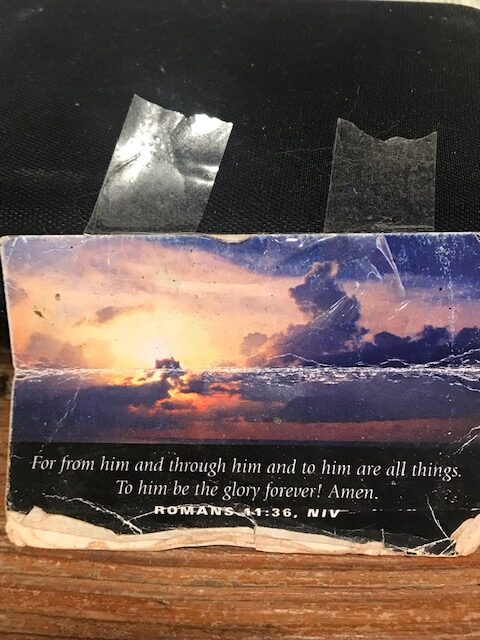
Divine little reminders. I stood up, walked over to the desk area and the big pad of paper on which I had outlined Chapter Four. By chance (ha!—see Ruth 2:3-4), I happened to glance at the little card taped to the top of the hutch cubby. Creased in half, with the edges partly rubbed off from having been carried inside my billfold for years, the front of the card was a picture of a glorious sunset over ocean, with Romans 11:36 at the bottom: “For from Him and through Him and to Him are all things. To Him be the glory forever!” (NIV)

“Soli Deo gloria.” Tears came, those tender tears that always come when we are deeply aware that God is saying something to us.

“Thank You, Father,” I murmured. Four times in the past few days I had read of people who used this motto specifically to dedicate their work to God: authors Jan Karon and Tracie Peterson and composers George Frideric Handel and Johann Sebastian Bach.

“Soli Deo gloria is the motto that grew out of the Protestant Reformation and was used on every composition by Johann Sebastian Bach. He affixed the initials SDG at the bottom of each manuscript to communicate the idea that it is God and God alone who is to receive the glory for the wonders of His work of creation and of redemption.” What Does “Soli Deo Gloria” Mean? (ligonier.org)

I finally heard what God was saying.   As I paused and just rested with God, I finally understood what I think God was saying to me through circumstances. I think God was reminding me that I had dedicated my life and my work to God and that I am doing all I can for Him, the best I can, so I can know that He IS indeed leading my steps. Furthermore, far from condemning my weaknesses, such as a tendency to dread hard things and to fret, God feels great compassion toward me and He will help me with my specific weaknesses , just as a father watches and knows just when his toddler needs to be picked up and carried.

Dear Father, I choose to believe and fix my thoughts on the truth that You are leading each step of my life, and that includes my work for You. I know You are in control of that as much as anything else in the world. And I know You will accomplish Your purposes in my life and my work for you as I simply do my little part and walk holy before You, with my whole heart.  And I know this applies to each minute and each aspect of my life, not only our writing.

What about your work and your life? Some of us can point to a specific task that is our work for God. For some seasons of life, however, our main work for God is more dispersed, like being a stay-at-home mom, working to support your family, or caring for a sick loved one.

Regardless, all of us have some specific gift we are to exercise.  And all of us are commanded to live our life for God, to be a living sacrifice for Him. That is the real day’s work for all of us. In Romans 12:1 Paul tells us: “Therefore, I urge you, brothers and sisters, in view of God’s mercy, to offer your bodies as a living sacrifice holy and pleasing to God—this is your true and proper worship.” (NIV).  And in Colossians 3;17 we hear “Whatever you do in word or deed, do all in the name of the Lord Jesus, giving thanks through Him to God the Father.”

You can, this very day, live for God, whether the main work in your life is in an office, a factory, a home with children, a church, a rock mine, or living your life for God while residing in a retirement community. You can do the same even if you are in a season where you must rest and get well, or where everything is happening too fast. You can purposefully choose to give this day to God. You can choose to live it for Him and for His glory.

“The trouble with life is that it is so daily.” (Chuck Swindoll) I must remind myself often that the everyday tasks of daily life—making breakfast, fetching home the groceries, housecleaning, paying bills, getting the car repaired—are as much a part of my life for God as when I am privileged to be seated at my desk writing. I must remember that God cares about the minutes and hours of the activities of my daily living as much as when I am doing something specifically for Him.

For that reason, I periodically reread the small book “The Practice of the Presence of God”. Written by Brother Lawrence, this short volume shows us how to be aware of God’s loving presence during all the hours of daily life, simply by turning to God with a humble, thankful heart.

“You can do it!!!” As I turned toward my desk with refreshed determination and confidence, I saw the Lego cat note holder one of my grandsons had made me for Christmas. On it he had written “you can do it!!!”  Notice the three exclamation marks. When I opened his gift Christmas morning, I knew it would be one of the things that has a permanent place on my desk.

This precious gift is, I firmly believe, another Divine “happenstance.”  My frail heart needs encouragement constantly and my heavenly Father knows that. So, God moves me to meditate on the numberless verses in the Word that strengthen the weak heart, He sends encouragement every day, and He sends courage through little pats on the head, like seeing that worn-out card and Ansel’s note holder today. God reminds me, and you, that, in His strength – you can do it!!!

Father, I ask that You send special tokens of encouragement to Your children today, in whatever way touches each one most deeply. Let someone they thought takes them for granted say thank you in a notable way. Let them see their favorite bird as they walk in to the office one more time or, one more time, start on a messy house. Let the flaming crimson and gold of a sunset warm their heart. Let a sense of well-being blanket them as they sit down for their evening meal.

Although we live by faith, not feelings, bless them this day with the awareness that You are right there with them, that Your love for them is higher than the heavens are above this beautiful earth. Let them know that You take delight in their love for You, that You sing over them, that You have written their name on the palms of Your hands. Make Your face shine upon them and give them Your peace that is more than we can understand.  Let them know that You are with them when they are with You.

Open their eyes, Father, and let them see signs of Your love and Your specific encouragement for them. In the mighty name of Jesus, amen!

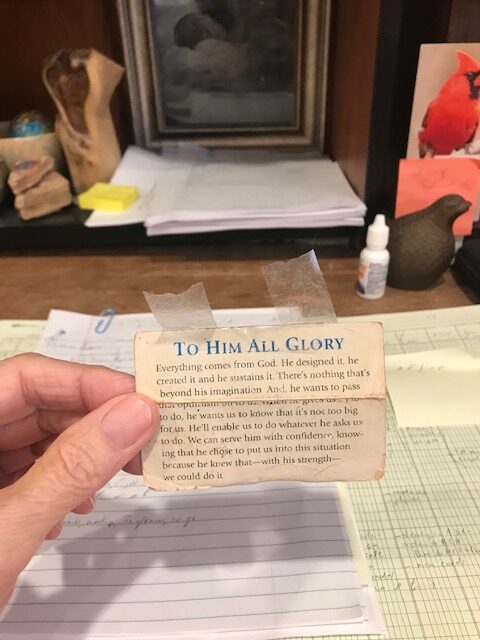
The message on the back of that card was:

Everything comes from God. He designed it, He created it, and He sustains it. There’s nothing that’s beyond His imagination. And He wants to pass that optimism on to us. When He gives us a job to do, He wants us to know that it’s not too big for us. He’ll enable us to do whatever He asks us to do. We can serve Him with confidence, knowing that He chose to put us into this situation because He knew that – with His strength – we could do it.

Friend, in God’s strength, you and I can do it!!!  If you have given your heart to Him, the same One Who tells the oceans where to stop is busying Himself with the details of your life. And He really, really loves you.

Are you fearful, like me?

The following poem can be sung to the melody of the beloved Christmas carol “O, Little Town of Bethlehem.” Try it.

[1] My fearful heart, my fragile soul, why do you doubt and fear?
for God your King is powerful, and He is very near.
He watches over you with care, takes note of where you go,
so wait and hope and expect Him. He’s helping you to grow.

[2] Here in the silence of my heart I’m learning to depend.
He’s teaching me from His great law to hide myself in Him.
He’s working all things for my good. In all things He is faithful,
to teach my heart to follow Him, to trust Him as I should.

[3] When life in this old evil world brings torment without cease,
our God wants our minds fixed on Him, safe, guarded, kept in peace.
He knows our every weakness, He knows our hearts are frail,
and so He sent Emmanuel. In Him we never fail!

[4] When you are feeling all alone, like you don’t have a friend,
remember Satan’s lies are lies, and trust makes darkness end.
For every time we call on Him, He answers us with light,
and on His strength we can depend!
We’re girded in His might!

“Are you fearful, like me?” is a trick question, sort of. I wanted to get your attention. I am not fearful in the sense that I know God is sovereign, I know that He is loving and faithful, and I know that not one word of all His promises ever fails. Yet, because I am human, feelings of all kinds occasionally splash up, like waves on seaside rocks. And, sometimes if I do not run to God quickly enough, feelings overwhelm my soul, as surely as the tide overwhelms (ah! but only temporarily) the ever-shifting shoreline.

We all have similar feelings. As the Word tells us, we humans all have similar feelings. Look at 1 Corinthians 10:12-13 in the New Living Translation.

12 If you think you are standing strong, be careful not to fall. 13 The temptations in your life are no different from what others experience. And God is faithful. He will not allow the temptation to be more than you can stand. When you are tempted, He will show you a way out so that you can endure (emphasis added).

The context for this comforting verse is Paul’s warning that the believers at Corinth not repeat the mistakes Israel did, when the Israelites “set their hearts on evil things” (v. 6), when they were idolators, adulterers and grumblers and tested the Lord. All these died in the dessert, never making it to the Promised Land.

Paul says “These things happened to them as examples and were written down as warnings for us, on whom the fulfillment of the ages has come” (v. 11). In light of that, Paul says we must be very careful, if we think we are doing well spiritually, to be careful and not fall into sin, because we are all subject to the same temptations.

12 Therefore let anyone who thinks he stands [who feels sure that he has a steadfast mind and is standing firm], take heed lest he fall [into sin].

13 For no temptation (no trial regarded as enticing to sin), [no matter how it comes or where it leads] has overtaken you and laid hold on you that is not common to man

[that is, no temptation or trial has come to you that is beyond human resistance and that is not adjusted and adapted and belonging to human experience, and such as man can bear].

But God is faithful [to His Word and to His compassionate nature],

and He [can be trusted] not to let you be tempted and tried and assayed beyond your ability and strength of resistance and power to endure,

but with the temptation He will [always] also provide the way out

(the means of escape to a landing place),

that you may be capable and strong and powerful to bear up under it patiently. (I Corinthians 10:12-13, AMPC).

Note that the emphases and the spacing are my interpretation and not included in the original text.

God will provide a way of escape. How comforting that last part of Verse 13 is! Read it again. No matter what temptation we face, God has promised He will not let it be more than we can endure and He will make a way out of it, a “means of escape to a safe landing place.” I like to think of that as a child running into his father’s strong and loving arms.

Why we must always be running to God.  Verse 14 is connected to what came before the “Therefore” that starts Verse 14. Because of what we just saw in Verse 1 through 13, we are to flee from idolatry, which means to shun, to consistently avoid loving or honoring or respecting anything or anyone more than we do God. Read this verse in the AMPC.

14 Therefore, my dearly beloved, shun (keep clear away from, avoid by flight if need be) any sort of idolatry (of loving or venerating anything more than God) (emphasis added).

So, verses 1 through 14 tell us if we are appropriately aware of our human tendencies–of all kinds, not just fear–we will seek, inquire of and for, and depend upon God as our first and vital necessity.

I think God is lovingly telling us here, as a father would tell a beloved son embarking on a journey: Now, remember, you cannot see in the darkness. You must walk only in the light.

And how do we do that? By keeping His Word in our mind – constantly. Three years ago, I was just starting to learn how to maintain healing from life-controlling depression and fear. What brought healing? Diligent, daily meditation on God’s Word. Desperation led me to meditate on comforting Bible verses hour after hour, all day long, during every free minute, every day, week after week, month after month. As I did that God’s Word healed my heart when all else had failed.

God has maintained the healing and helped me grow. How? By moving me to continue delighting in His law and diligently meditating “on His law day and night.” (Psalm 1:2, NIV).

Still desperate about His Word. I am still desperate about His Word because I have learned I can do nothing without Him but that “I can do everything through Christ Who gives me strength.” (Philippians 4:13, NLT) By His grace I can now say to my loving, gracious Father:

I will keep Your law continually, forever and ever [hearing, receiving, loving, and obeying it]. And I will walk at liberty and at ease, for I have sought and inquired for [and desperately required] Your precepts. (Psalm 119:45, AMPC)

Other carols for consecration.  If you like the poem above, and the idea of more verses for your favorite Christmas carols, see “Carols for Consecration” on the Books and More page of this website or the link below.

Carols-for-Consecration-.pdf (wordsofhopeandhealing.com)

I pray you will be helped to meditate more and more on God’s powerful Word. And find more and evermore peace during this season, this blessed season when God  Himself came to earth to bring peace on earth and “good will to men.” (Luke 2:14, NIV).

God says: Soar!

That soaring hawk. The waiting room was quiet, but I was not waiting quietly, at least not on the inside. Then came the blast of the Keurig machine and that wonderful penetrating aroma of fresh coffee. I knew that machine was there in the reception area because one half of this large office did cardiac stress tests, including chemical stress tests where people sometimes had a reaction that was helped with a simple cup of coffee. I had experienced that last year.

“Oh, Lord! I hope the doctor does not tell me I need another one of those this year!”

Tired of sitting, I walked over and stood in front of the floor to ceiling windows on the second floor of the doctor’s office. Since third grade, being even one floor above ground brings me back to the first time I was in a home with a second floor, when our Florida family visited my paternal grandmother in Nashville. I can still see Granny, smiling and leading us all through the side-entrance and up the narrow, carpeted, tunnel-like stairway to her second-floor apartment where, wonder of wonders, you looked right into the branches of trees.

The simple charm of that came back as my eyes traced the wave-like line of treetops. Then I saw it, just a spot at first, in the distance. Moving in narrow arcs from side to side, the hawk drew closer. As it drew closer the width of those arcs increased. The bird soared, wings fully opened, moving only to change altitude or make a turn and even then, only making slow, gentle flaps as its body angled into the turns.

Like many modern doctors’ offices, the entire wall was floor to ceiling windows.  I watched as that hawk flew left and right, back and forth, turning just as it was about to go out of my sight and going back in the other direction, over and over and over. Like it was performing, dancing in the air, just for me, it flew. Effortlessly.

“Lord, thank You. I get it. That hawk is soaring, as an eagle, just by spreading its wings. It is riding on the wind. I know You want me to mount up over the difficulties of life this day to soar with You, as You say in that verse in Isaiah 40. I know You want me to enjoy this day and be glad because You have made this day for me. It is no accident.” (Psalm 118:24)”

Isaiah 40,“a grand chapter.” Isaiah 40, which contains that well-known verse about mounting up like an eagle, “is a grand chapter” as Henry H. Halley said. Verses 1 through 11 speak of the coming of Jesus. Verses 12-31, the rest of the chapter, speak of “the infinite power of God, and the eternal youth of those who trust Him” (Halley’s Bible Handbook, p. 385). To read the entire chapter is to walk, not on a field strewn with diamonds, but a field comprised of diamonds. We will pick up but a few diamonds of truth in this short writing, just enough to get the context for Isaiah 40:28-31, the passage we will focus on.

Isaiah 40 is the first chapter of a lengthy passage (chapters 40 through 56), that presents God’s promises of the coming deliverance for His people. God starts this discourse with “Comfort, comfort My people” (Isaiah 40:1, AMPC) and then He tells them to get ready because He, their sovereign Lord is coming “with power.”

Then Isaiah shifts into one of the many sublime passages in the Word that describe God’s power. We hear the same thunderous truths we hear when God addresses Job in Job 38 through 41. In Job 38, God asks Job “Where were you when I laid the earth’s foundations? (v. 4)  Have you ever given orders to the morning, or shown the dawn its place? (v. 12), Have you comprehended the vast expanses of the earth? (v. 18). In Job 39, God asks Job “Do you give the horse its strength or clothe his neck with a flowing mane? (v. 19). “Does the hawk take flight by your wisdom and spread his wings toward the south? Does the eagle soar at your command and build his nest on high?” (v. 26-27). (NIV)

Similarly, in Isaiah 40 we hear God ask:

Verse 12-15. “Who has measured the waters in the hollow of His hand, or with the breadth of His hand marked off the heavens?” and “Who has understood the mind of the LORD, or instructed Him as His counselor?” Then God says that “before Him all nations are as nothing; they are regarded by Him as worthless and less than nothing.” (v. 12, 13, and5a).

Verse 21-24. God asks haven’t you heard? Don’t you know that God reigns over all that is, and that He is omnipotent, omnipresent.  “He sits enthroned above the circle of the earth, and its people are like grasshoppers.” 

Verse 25-26. With that in His listener’s minds, God, our Holy and loving God, then asks, “To whom will you compare Me? Or who is My equal?” Look up at the sky and think about Who made the heavens. Think about Who calls each star by name and keeps them all, right where they are.

Verses 27-31. God then asks, in view of all that, why do you think God is not watching you? “Why do you say, O Jacob, and complain, O Israel, ‘My way is hidden from the LORD; my cause is disregarded by my God.” (NIV) God asks haven’t you heard, don’t you know, that “The LORD is the everlasting God, the Creator of the ends of the earth.” And He never tires, He understands everything, and He gives strength to those who are weak. Even when human strength fails, God gives new strength to those who hope in Him. Then they soar and move forward like the most majestic creature of the air. They run and do not grow weary.

What does waiting mean? Let’s look at Verse 31 in the Amplified Bible

“But those who wait for the LORD–who expect, look for, and hope in Him—shall change and renew their strength and power; they shall lift their wings and mount up [close to God] as eagles [mount up to the sun]; they shall run and not be weary; they shall walk and not faint or become tired.” (Isaiah 40:31, emphasis added, AMP)

That word wait is rendered, in various translations, as wait, hope and trust. I’ve most often heard it quoted as wait. Notice that “waiting for the LORD” means to “expect, look for, and hope in Him.” In our humanity, we want to obey God and immediately see results. We want to read a verse, do what it says and see God move immediately, certainly within a day or two. But waiting, by definition, means a time of staying where you are until something happens. Webster’s 1828 dictionary defines wait as “To stay or rest in expectation; to stop or remain stationary, till the arrival of some person or event.” So, we must trust God, and wait for Him—with patience and expectation and hope. Then comes the result.

How does God say to wait? We are not only to wait. We are to wait with hope and confident expectation. While we wait with confidence in Him, God helps us and that gladdens our heart. Consider Psalm 28:7. “The Lord is my Strength and my [impenetrable] Shield; my heart trusts in, relies on, and confidently leans on Him, and I am helped; therefore my heart greatly rejoices, and with my song I will praise Him.” (emphasis added, AMP).

But what if we have no hope? What if we are not confident God will answer? God understands the heart. That is why He told us It only takes a mustard seed size bit of faith (Matthew 17:20).  I believe that is why He included Mark 9:14-25 in the Bible, that story of the boy horribly afflicted by an unclean spirit. When Jesus told the boy’s desperate father anything is possible, the father cried “I do believe; help me overcome my unbelief.” (NIV) That’s how honest we must be with God.

And if we do not feel even that much faith, He will give us the desire to feel it. In Philippians 2, Paul reassured people who were continuing to grow in the Lord that God would give them not only the strength and, power to do His will but the desire as well.

 [Not in your own strength] for it is God Who is all the while effectually at work in you [energizing and creating in you the power and desire], both to will and to work for His good pleasure and satisfaction and delight. (Philippians 2:13)

Living, active faith. Do you see that this waiting God requires is not passive, but rather active? There is an if/then, cause/effect link between God’s kind of waiting and the rewards He promises. We hope confidently in Him. Then we wait. Then He renews our strength.

We start the process of waiting with hope and expectation by taking a leap, by choosing to believe and by saying I will trust that God will rescue me. Consider Psalm 91. If we dwell in the secret place of the Most High (verse 1) and if we say ‘God is my refuge and my fortress and I trust Him with confidence’ (verse 2), then all the promises in the rest of Psalm 91 apply.  I must declare, or say explicitly, that I am trusting in God, with confidence. That is active faith.

We see the same principle in Psalm 33:21. If you invert the clauses in that verse you get something like – because we have trusted, relied on and been confident in the Lord’s holy nature, our heart rejoices in Him (Psalm 33:21, AMPC paraphrased).

Again, this is what Jeremiah does in Lamentations 3:19-28. Because Jeremiah knows God is good to those who wait for Him hopefully and expectantly (v. 25) Jeremiah’s heart cries out, he takes a leap and says, “The Lord is my portion or share, says my living being (my inner self); therefore will I hope in Him and wait expectantly for Him.” (v. 24) Jeremiah is saying he is trusting God as His allotted portion in life, just as the priests in Bible times received their sustenance from the people because God was their portion, their provider. The rest of the Israelites, the non-priests, worked in the fields to get their food, but the priests were provided food by God, through the other Israelites, because the priests spent the hours of their days serving Him. God was the portion of the priests (Numbers 18:20).

Eagles leap, then soar. While writing this blog post I looked at slow motion videos of eagles soaring. Then I wondered how do they start soaring? God embeds deep teachings in nature. Eagles start soaring by taking a leap. Although they can, somewhat passively, simply stretch out their wings when they soar, they start soaring by taking a leap.

I will not soar with God, resting in His strength, until I take a leap and choose to hope in Him, with confidence, expecting that He will come through for me.

Watch the video at the link below or find another one by typing “slow motion video of eagle taking off” into a search engine. Do you see that initial leap the eagle takes? As the eagle leaps, he starts spreading his wings. Look at the strength and power in those wings, and those bones in those wings, arms and elbows so to speak, as they bend and reach out, the muscles and corded tendons contracting then stretching out. See the feathers unfurl and spread.

Beautiful eagle takes off in 0.2 seconds – super slow motion – YouTube


Notice how the wings change shape. See how very, very wide the wingspan is in proportion to the body. Notice how high up the wings reach and then how far down. “Eagles fly by utilizing their impressive wingspan, muscular bodies, and specialized flight adaptations…including a wing structure designed for maximum efficiency and the ability to manipulate wing shape and angel for lift and energy efficiency.  How Do Eagles Fly? Revealing the Secrets of Their Soaring | Learn Bird Watching

Such a symphony of complexity, yet eagles leap then soar with ease because God made them with that capability.

You can do it!  God commands the eagle to soar (Job 39:26) but within that command is the command to leap. It may not feel like it in some circumstances, but God has made us with the capacity to take leaps of faith and soar, with Him, above the worries of this earthly life. It all begins with choosing to believe His Word, by taking a leap. Friend, you can do it because God is working in you.

bald eagle flying on skies

Photo by Mathew Schwartz on Unsplash

I didn’t feel like being grateful

I didn’t feel like being grateful. My right foot began to throb as I depressed the brake, waiting at the light. I ran my thumbs over the smooth curve of the steering wheel, impatient.

“I am so tired of all these physical problems!” I moaned to myself. “Is part of the foot pain coming from the low back, like that one doctor said? Or is it something else? And if it is, how am I supposed to pay for the decompression treatments he said would likely help?”

The gray, overcast day reflected my mood. For days, impenetrable murk had hidden the shape of God’s vault of blue heaven above. Instead of feeling lifted up and free upon stepping outside, oppressive gray clouds weighed heavily on the mind, closing you in, stealing the chance for an upward, hope-giving glance at that inverted bowl of blue and the majestic mountains of white clouds.

Across the intersection, I saw a gray-haired man in a wheelchair, also waiting for the light. Time flashed back thirty years, to one of those moments that, when you experience it, you know you will always remember.

Thirty years ago I had been driving home from my secretarial job where I sat outside the door of a sarcastic, mean, and hyper-critical boss. I was feeling sorry for myself, dreading sitting down with the bills when I got home where I would have to stretch my single-parent income beyond belief, and angry that my daughter, at age 15, worked at McDonald’s so she could have extras like magazines, make-up to experiment with and an occasional movie. There, bumping along on the side of the road, in the uneven dirt, was a young man in a wheelchair. There were no feet propped on the footplates of the wheelchair.

Instantly a saying from Al-Anon days came to mind. “I complained because I had no shoes until I met a man who had no feet.” That day, through tears, I had counted my blessings, literally, all the way home.

Now, as I sat at the light, looking at that old man in the wheelchair, recalling the lesson God had written on my heart so long ago, I knew something was really wrong. I still did not feel like being grateful, even after such a direct message from God.

Why was I floundering? The immediate reason for my sour mood was that I was returning from the gym, to which I had driven for the swim which aways eases my back. But three minutes in, they closed the pool for chemical rebalancing. The light changed. I resumed my fuming.

“I have to exercise more than anyone else I know and I still have so many physical problems. That is not fair!”

As I pulled into the parking lot, light finally penetrated my darkness.

“Lord, You promise to work good out of everything so I am going to see what lessons You have for me in this experience. I am going to get good out of this. Please help me get my attitude right, Lord! I am sorry but I am really mad about everything!”

I inhaled deeply as I walked toward the stairs, enjoying the smell of the drizzle that was starting and the slight chill in the air that gets pleasantly into your bones, so refreshing after months of sticky heat. As I unlocked the door, insights flooded in. I was reminded of the series of blog posts I had just finished on Isaiah 30, which teaches that all the time we have turned away from God He is eagerly waiting, looking and longing to be gracious to us (Isaiah 30:18) and that He fights our enemies for us when we return to resting and depending on Him.

Like a pouting little child stamping her foot, I had, finally, looked up at my Heavenly Father and raised my arms to Him. And, like the father of the prodigal who was eagerly watching for his son to return, God ran.

The blessings of insights from God. How blessed we are that God invites us to talk things over with Him. In Isaiah 1:18 He says:

“Come now, and let us reason together, says the Lord. Though your sins are like scarlet, they shall be as white as snow. Though they are red like crimson, they shall be like wool. (AMPC.)” And James 4:8-11 tells us “Come near to God and He will come near to you. Wash your hands, you sinners, and purify your hearts, you double-minded. Grieve, mourn and wail. Change your laughter to mourning and your joy to gloom. Humble yourselves before the Lord and He will lift you up. (NIV)

Prayerfully I reviewed what had gotten me into such a vile state of “unworthy and unwarranted suspicions regarding God’s faithfulness.” (Jeremiah 15:19, AMPC). For days, I had tried to be grateful, to just talk with Jesus about the problems, ignore those fickle old feelings and just move forward. For days I had been unable to feel His presence and His peace. So, despite strong effort, worry, fear, anger and resentment settled into my heart.

Oh, those foxes, those little foxes! [My heart was touched and I fervently sang to Him my desire] Take for us the foxes, the little foxes that spoil the vineyards [of our love], for our vineyards are in blossom.” (Solomon 2:15, AMPC). When I look back now, now that I have, by grace, regained peace, the problems that made me stumble seem so little. I am sure you could write a similar list. Mine was ongoing and worsening back problems; no funds to cover the treatment that might help; ongoing and worsening foot problems related to that; the need for minor foot surgery in two weeks, surgery that would further complicate all the back problems when I could not exercise for a while afterwards; having to wait three weeks for insurance to cover new eyeglasses; worsening eye pain and strain each day, not knowing if that was caused by the need for new glasses or cataracts or dry eye, the expensive remedy for which insurance also did not cover.

It seemed that everything I use each day, to just live and to write, which is a great joy, was falling apart. Another contributing factor to self-pity and irritability was the lingering week-long cold.

“Why couldn’t I be grateful for all God had done?” I asked myself as I reviewed the blessings God had showered on me this week: stopping the blood thinner, which had caused much fatigue for an entire year; getting me unstuck after weeks of struggling with a hard chapter in the next book; and showing how to modify some daily activities so as to help with feet and back issues.

Besides all of that, there were the huge, huge blessings that are a part of daily life: salvation, a close relationship with Him, some of my family being saved and faith to believe for the others; living close to family; living in America; money for all my needs and many of my wants; deliverance from depression; training in keeping emotions stable; and the knowledge of how to return to God when I sin and/or bad things happen.

God’s deliverance. So, here is what I told myself to do.

[1] Ask God to forgive me for my wrong attitudes and complaining and ingratitude. Two verses I greatly value are: 1 John 1:9, which says “If we confess our sins, He is faithful and just to forgive us our sins, and to cleanse us from all unrighteousness. (NIV)” So simple. So necessary. The second is Proverbs 28:13 which teaches us that “Whoever conceals their sin does not prosper, but the one who confesses and renounces them finds mercy.” In doing that, we humble ourselves under God’s mighty hand and He will lift us up in due time, as He promises in Peter 5:6-7.

Confessing our sin is doing what James 4:7-10 commands us:

7 Submit yourselves, then, to God. Resist the devil, and he will flee from you. 8 Come near to God and he will come near to you. Wash your hands, you sinners, and purify your hearts, you double-minded. 9 Grieve, mourn and wail. Change your laughter to mourning and your joy to gloom. 10 Humble yourselves before the Lord, and he will lift you up.

[2] Make up my mind to God thanks for everything I can think of, no matter how I feel, and to praise Him. I Thessalonians 5:18 tells us “Give thanks in all circumstances; for this is the will of God in Christ Jesus for you.” (ESV) Psalm 100:4 tells us to approach God with thanksgiving and praise in our hearts. Consider this quotation from Debbie Przybylski on www.crosswalk.com.

God inhabits our praise. The word “inhabit” or “enthrone” (yashab) means to judge in ambush. When we praise God, He will seat himself right in the middle of our lives and judge the enemies that are surrounding us. The Japanese translation of Psalm 22:3 is: “When you praise God He brings a big chair and sits there.” Think about that! God is seated in the center of your life. The enemy cannot dethrone you because God cannot be overthrown!” https://rb.gy/fz4791

[3] Ask God to impress the lesson of this painful experience deeply on my heart. Psalm 103:18 in the AMPC has a vital lesson for me. Verse 17 says that “. . . from everlasting to everlasting the Lord’s love is with those who fear Him. . . “(NIV) The thought continues in verse 18: “to such as keep His covenant—hearing, receiving, loving and obeying it; and to those who [earnestly] remember His commands to do them [imprinting them on their hearts] (emphasis added). To me this verse says that when we earnestly, whole-heartedly, lovingly obey the Lord we imprint, or write, His word on our heart. This is part of the new covenant we now have through Jesus that God explains in the book of Hebrews. In Hebrews 10:16 God says “I will imprint My laws upon their hearts, and I will inscribe them on their minds (on their inmost thoughts and understanding.)” (AMPC)

Taken together, these verses reassure me (and, oh how I need that reassurance!) that as I follow God’s commands God imprints them, like a brand, on my heart and mind. This is part of how He works in my heart to give me godly desires and enables me to live a holy life (Philippians 2:13). He is changing my nature so that I want to love and serve Him even more.

Verse 14 of Psalm 103 is also instructive in this matter. It says that God understands exactly how we are made. “For He knows our frame; He [earnestly] remembers and imprints on His heart] that we are dust.” (AMPC). This says to me that if God imprints on His heart how much we need His compassion, we should imprint what He wants us to do on our hearts. If He loves us so much, how can we not respond appropriately? Selah. See what Holy Spirit tells you about these two verses. And all of Psalm 103.

[4] Thank Him for His loving discipline (Hebrews 12). In times of trial, whether we are partly the cause or not, it is well worth taking time to ponder the truths of Hebrews 12:1-13 and John 15:1-17. God uses hardships to train us, for our good, so that we may share in His holiness (Hebrews 12:10b). He trims or removes from our lives the things that bear no fruit and He also works with the things that do bear fruit so that those things may bear even more fruit (John 15). Clearly, some of my branches needed to be cut off and thrown away. However, God was lovingly working with my heart so that the faith, hope, trust, and self-control I had would increase.

Two thoughts to keep in mind. So dear friend and fellow oh so human human being, here are two thoughts that I pray will ease your heart as they do mine.

One, God knows exactly how you feel and has deep compassion on your fleshly tendencies whether you are a new believer or 50 years old in the Lord. He included many stories in the Bible about mature saints who yielded to complaints, worries, and fears. And He included how He loved and worked with them every time when they sought Him. Consider the failings of Moses, Elijah, David, and Jonah, just for starters.

And two, God is not mad at you for automatic, instinctive reactions of your flesh. Pinch my arm and my flesh reacts with physical pain. Pinch my circumstances and my flesh reacts with negative emotion. It is a trap of the enemy to feel guilty about such feelings and let them continue, subconsciously feeling we have failed Him and He must be mad at us.

Even when we, being so very human, let wrong thoughts stay in our heart, God is not mad at us any more than a parent is mad with children who react in childish ways. He just longs to lift us up and restore us to His side. Think of how often He forgave the Israelites as they wandered in the wilderness and then when they lived in the land He had promised.
When you see a little child stumble and fall and you hear that piercing wail of distress you want to pick up that child, hold him close and tell him everything will be alright. You feel that child’s pain. That is compassion.

How much more does God feel compassion for us when we stumble? In Isaiah 49, God says His love for us, and His consciousness of us, is greater than that of a mother with a tiny infant. In Isaiah 49:16 God says “See I have engraved you on the palm of my hands;” (NIV)
Beloved one, “The LORD is gracious and full of compassion, slow to anger and abounding in lovingkindness.” (Psalm 145:8, AMPC). To be filled with something is to have no room for anything else. Do a word study on God’s compassion.

No matter what is happening in your life, no matter how your feelings have reacted, humbly present yourself to God. He will lift you up “. . . for He is good; for His mercy and lovingkindness endure forever.” (Psalm 118:1b and 29b, NIV) Every verse in Psalm 136 repeats that statement. Think about why God did that. He did that for you.

God will always raise you up, to make you more than you can be, because He loves you. Ponder that as you listen to “You Raise Me Up”.


Many sparrows

Early morning thoughts. I took a sip of tea, leaned forward and opened the blinds behind the desk. There, in the yellow halo of light from the blazing security light affixed to the wall, three small gray and brown sparrows perched in the entwining branches of the crepe myrtle trees screening the window of my second floor condo. Two had their heads tucked under their wings, demonstrating all the flexibility usually attributed to those of the feline persuasion. The third miniature beauty was occupied with his morning ablutions, pecking his tiny beak atop, behind and under his uplifted snippet of a wing.

Beyond and to the sides of this sparrow’s bedroom of light there in the tree branches, darkness was still really dark, stirring, as it always did, tender memories of high school mornings when my father, who arose at five to go to the rock mine, sometimes woke me when I had a paper due or needed an extra hour of piano practice.

“How can that be so many decades ago now?” I wondered. “Thank You, Lord, for those two Scriptures yesterday, that one in Isaiah and in Psalms”.

 Even to your old age I am He, and even to hair white with age will I carry you. I have made, and I will bear; yes, I will carry and will save you. (Isaiah 46:4, AMPC)

 I will come in the strength and with the mighty acts of the Lord God; I will mention and praise Your righteousness, even Yours alone.

O God, You have taught me from my youth, and hitherto have I declared Your wondrous works.

 Yes, even when I am old and gray-headed, O God, forsake me not, [but keep me alive] until I have declared Your mighty strength to [this] generation, and Your might and power to all that are to come. (Psalm 71:16-18, AMPC)

Coping with problems. I had recently started going to bed earlier so that I could get up earlier for the specific purpose of dividing up time spent sitting at the computer, part of ongoing efforts to keep on with the work of writing despite the recent barrage of age-related challenges like eye strain, stiff joints, fatigue, and on and on.

But today, looking at the sparrows I am richly blessed as the word of God comes to mind, as always bringing truth and therefore peace. The truth is that I am exceedingly blessed, in countless ways. Having a home, food, a car, the freedoms of living in America are things I try to remember to thank God for daily. But I also thank Him for the health He has given and for the wisdom He gives in how to keep going, and even laugh, in spite of the problems associated with old age and white hairs.

So, this morning as I look at the sparrows, I think:

“Finally, I get it Lord . . . there are many sparrows. Many. And I am worth more than many of them, You said. As they simply perch and sleep, and awake and happily chirp the day awake they do not worry how they will do their job of finding food. If one of them is a little older and is feeling stiff, they do not worry.

Two days later. . . I was having a great day, with an unusually long stretch of time to write since it was not only a rest day from exercise but also a day with few other chores to do as well. Most of the morning, I spent happily combining ten or so separate files into one, closing in on the process of getting the book “Undepressed” ready to put on the website, hopefully by the end of this month.

At one, I took an hour’s rest, flat on the bed, part of my self-imposed health habits that help greatly. After a bite of lunch and a quick quiet time, I was debating whether to continue work on compiling files or to return to work on the new book about becoming a believer when a text pinged.

“We have noticed suspicious activity on your account. If you did not authorize the following transaction, text N to this number. . . “

Well, that led to four more text messages, with waits in between each, and then the text “Your debit card has been cancelled due to fraudulent activity. Please see your financial institution or call this number for a new card. . . “

Aaaarrgggghhhhh!

“Just when things are going so well, just when I have some extra time, just when I was in such a good mood. . . “ began the silent fuming.

But, by grace, not for long.

“I am sorry, Lord. Thank You for catching this attempt at fraud.  Thank you that they only got one hundred dollars before the fraud protection system stopped it. Help me redeem this time, Lord. Let there be someone at the credit union that I can witness to. Help me have a good attitude.”

Well, there just was no chance to witness to anyone. I got a new card, was given the phone number to call and dispute the fraudulent charges, and advised, which I already knew, that any automatic payments that had been set up on the old card would have to be re-established.

I walked back out into the Texas sun, still highly irked at the loss in time and the loss of the good mood. I had so much I wanted to get done today!

But, as I pulled back into the parking lot and walked to my unit, I realized it had only taken an hour. The credit union was less than two miles from my home, there had been only a short line, and I could probably have the money taken by fraud restored.

How He takes care of sparrows. That’s when I remembered this blog post I had started a couple of days before, and I thought.

“Lord, part of the way you take care of the billions of sparrows in Your world is through protecting them from harm, just like You protected me from financial harm. And those sparrows do not worry or fret about cats or birds of prey or other dangers, once they are passed.”

I sat back down at my desk and thought about the day and other blessings and protections. I had been up at five to drive someone I love to the hospital for a procedure, where all turned out to be fine, a blessing to that person and to me. On the way home, I had been passed on the interstate by two fire engines and an ambulance, on their way I soon saw as I creeped along in the backed-up traffic, to a bad car accident. Had I not had to wait an hour at the hospital while the check-in snafu got untangled before I left, I might have been in that accident.

“Father, like a child fussing because his papa will not let him cross the street when cars are coming or a child throwing a tantrum because she cannot have a cookie thirty minutes before dinner, I have whined and been mad about delays today. And all the while You have been protecting me. Forgive me, Lord, and show me how to be more grateful for all the hours and hours of time You give me every day and all the blessings You constantly pour out.

 Help me truly consider the lilies and the sparrows. Give me the heart of a trusting, non-complaining and grateful child.”

Biblical basis. As ever, I cannot seem to write short blog posts! In looking up the well-known sparrows reference I found that Jesus used the metaphor of sparrows and another time He used ravens and lilies to tell us not to worry. Most of Mattthew 10 contains the instructions of Jesus to His disciples when He was sending them out to minister. He warns them that they will be persecuted and tells them not to worry because they are “worth more than many sparrows” and God cares for every single sparrow.

In Luke 12, Jesus was addressing not only His twelve disciples but a large crowd as well.

22 Then, turning to his disciples, Jesus said, “That is why I tell you not to worry about everyday life—whether you have enough food to eat or enough clothes to wear. 23 For life is more than food, and your body more than clothing. 24 Look at the ravens. They don’t plant or harvest or store food in barns, for God feeds them. And you are far more valuable to him than any birds! 25 Can all your worries add a single moment to your life? 26 And if worry can’t accomplish a little thing like that, what’s the use of worrying over bigger things?

27 “Look at the lilies and how they grow. They don’t work or make their clothing, yet Solomon in all his glory was not dressed as beautifully as they are. 28 And if God cares so wonderfully for flowers that are here today and thrown into the fire tomorrow, he will certainly care for you. Why do you have so little faith?

29 “And don’t be concerned about what to eat and what to drink. Don’t worry about such things. 30 These things dominate the thoughts of unbelievers all over the world, but your Father already knows your needs. 31 Seek the Kingdom of God above all else, and he will give you everything you need.

32 “So don’t be afraid, little flock. For it gives your Father great happiness to give you the Kingdom.

33 “Sell your possessions and give to those in need. This will store up treasure for you in heaven! And the purses of heaven never get old or develop holes. Your treasure will be safe; no thief can steal it and no moth can destroy it. 34 Wherever your treasure is, there the desires of your heart will also be.

As Halley’s Bible Handbook notes “Jesus had favorite sayings that He repeated again and again. One of them was about God’s unfailing care for and guidance of His people.” (p. 669).

How gracious God is to bring His Word to our minds again and again, and again, and just when we need it, just as He provides food each day for every sparrow. And part of His daily manna this day, this hour, for this all-too-human human being is this verse:

Casting the whole of your care

…….[all your anxieties, all your worries, all your concerns,

………once and for all] on Him,

…..for

…….He cares for you affectionately and

……………..cares about you watchfully. (I Peter 5:7, AMPC) (emphasis added)

Lord, please keep reminding Your silly child that I am worth more than many sparrows and that You are watching over me, affectionately, every moment of every day!

Why do I need more gratitude??!!

Frustrations of daily life. I stared out the car window at the intersection twenty feet away. The Texas sun glared off each windshield and every piece of chrome on the cars passing by. Although the air conditioner blew blessedly cool air on my face, I could mentally feel the already blistering heat. Ten forty-five. I had planned to be back home seated at the computer by now.

I had driven by this in-and-out vehicle inspection site, one a half miles from my home, earlier but had passed it by because of the long line. Then I had driven two miles to another shop that the internet said did inspections. However, a sign just above the bays where you drive your car in for an oil change said “Sorry, but we no longer do state vehicle inspections.” I had backed up in a corner in their little parking lot, out of the way and, trying not to be mad, looked up “car inspections near me.”

“Ug!  I hate the internet! I said, my voice loud in the car’s interior.  “Why is it so hard to look up anything anymore!”

The list of inspection sites on my phone showed a phone number and links to a website and directions but without clicking on the directions, there was no way to tell the address. The little map with pins on it did not have the streets labelled.

I could feel my breath getting shorter as the irritation rose. I could also feel a twinge of chest pain. That often happens lately when I start getting upset. I consider it my personal early warning system, an urgent message to calm down NOW and take things slower NOW.

(If you have chest pain, please see a doctor. I pay attention to chest pain but I can, with a fair degree of confidence, modify my behavior and wait for it to ease because I am under the care of a cardiologist who so advised me.)

So, trying to calm down I hit the directions button and followed the voice to the next site. I parked and walked to the door. Another “We no longer do vehicle inspections.” The thin skin over my elbow felt like it was roasting. Back in the car, one more sip of the iced water I carry with me all summer long, one more session with the phone, then one more site and one more sign.

“I give up.” I said and drove back to the original site close to my home.  Thankfully, there were only two cars in each of the two lanes ahead of me. I pulled in line and waited. And waited. And waited. Finally, a man came to my window, took my payment, then said as he reached for the handle of the car door, “We’ll take it from here.”

This was one of the speedy inspection stations/speedy oil change places and it looked, from driving by, that you sat in the car while the car was inspected or the oil was changed.  I had come here because I did not want to go to a service shop where you had to sit and sometimes wait an hour. That was hard on my touchy hip.

Stifling another deep sigh—it was not this young man’s fault and I was sure he saw disgruntled faces all day long—I asked “Where am I supposed to wait?”  I realized that sounded sarcastic.

He gestured to two picnic benches resting, barely, in the shade of a little Mexican restaurant, then pointed at the crew of men paving the section of asphalt driveway next to the inspection building.

“They are paving our spot.”

Too upset to immediately hear the sarcasm in my words and apologize for sounding upset, as I normally would have done, I nonetheless was aware I needed to do something.

“Thank you,” I said with a softer tone and an attempt at a smile. “I appreciate it.”

Forgive me, Father. I am listening now. I walked the twenty feet to the two picnic tables, grateful that the corner of one bench was still in a three-foot wide strip of shade before the advancing sun removed that one last bit of shadowed coolness in the entire block. The air was filled with the tantalizing smell of cooking beef.

“Okay, I said, “I’ll start the book I brought with me on do-it-yourself physical therapy for your knees.” But when I looked in my purse, I realized I had left the little book in the car.

Once again, I sighed. “Okay, Father. I realize You are trying to tell me something. I am sorry for getting so upset. I will just sit here and listen for what You want to say.”

I looked again at the intersection next to the inspection site, at the hot glare, the cars whizzing by, going in four directions. People out and about, many of whom would not have the luxury of going back home and staying inside, out of the heat, for the rest of the day.

seven construction workers standing on white field

Photo by Scott Blake on Unsplash

Then I looked at the construction crew. Two men were using huge push brooms to smooth out the fresh asphalt. They all had long sleeve shirts and long pants on, a phenomenon I had thought peculiar when I first came to Texas ten years ago from Florida. I had learned since that people wear long sleeves because the Texas sun is more vicious than the Florida sun which passes through softening, highly humid air.

“How hot are they?” I wondered. “And they do this kind of work all day and all year long.”

There was a loud repeated thudding as some machine, just out of my sight, pounded away, breaking up a new section of pavement to be worked on, I presumed.

“And they have to listen to loud machinery all day long, too.’

“Freda, you need to be more grateful and stop complaining! What a wimp you can be! You are acting just like the Israelites complaining about sweet tasting manna.

“Expect trials to multiply.”  Then I thought of the devotional by Charles H. Spurgeon God had brought to my attention through a friend earlier that morning. When I got home, fifteen minutes later, I pulled out my well-worn copy of “Beside Still Waters” and turned to page two. It began:

“God does not put heavy burdens on weak shoulders. God educates and tests our faith by trials that increase in proportion to our faith. God expects us to do adult work and to endure adult afflictions only after we have reached a mature status in Christ Jesus. Therefore, beloved, expect your trials to multiple as you proceed toward heaven.”

Spurgeon expounded on that theme, recalling that, in Abraham’s old age God had tested Abraham (Genesis 22:1).  Spurgeon warned “to never plan on a rest from trials this side of the grave.” He concluded by reminding us that we must stay in the fight and use our armor because we are in a war. We “must watch, pray and fight” and we must expect our “last battle to be the most difficult, for the enemy’s fiercest charge is reserved for the end of the day.”

Finally, deep understanding. This was a theme I had danced around in my solitary ponderings and in conversation with a friend who has also undergone a long string of troubles and trials, as I am sure you have also. But this time, on this pyretic morning in Texas, going about the routine of taking care of the ever-growing mound of small and trifling matters necessary to sustain life in our world, God gave the strength necessary to truly embrace this truth and accept it, rather than run from it as I had before.

Why I need to be more grateful. “Okay, Father. I see this clearly now. And I also see that You have all these last few months, with all these challenges, been equipping me with one of the best shields, that of developing a truly grateful heart.

You know when I first started consciously trying to be grateful, for the everyday little things right in front of me as well as for seemingly big things, it felt like just an exercise. I still had so much complaining going on inside at the same time I was saying ‘Thank You, Father, for this home, this furniture, all the food in my cabinets, the money that pays the bills, the dependable car I drive. . .’

But it has become more sincere and now I really mean it when I express my gratitude to You. You have renewed my heart.  Thank You, Father. I could not do it, no matter how hard I tried but You did.

And this is part of why You wrote Philippians 4:6-8 too, isn’t it, where You told us not to worry, to just ask You for what we need and to keep our minds fixed on good things.

 6 Do not fret or have any anxiety about anything, but in every circumstance and in everything, by prayer and petition (definite requests), with thanksgiving, continue to make your wants known to God.

7 And God’s peace [shall be yours, that tranquil state of a soul assured of its salvation through Christ, and so fearing nothing from God and being content with its earthly lot of whatever sort that is, that peace] which transcends all understanding shall garrison and mount guard over your hearts and minds in Christ Jesus.

8 For the rest, brethren, whatever is true, whatever is worthy of reverence and is honorable and seemly, whatever is just, whatever is pure, whatever is lovely and lovable, whatever is kind and winsome and gracious, if there is any virtue and excellence, if there is anything worthy of praise, think on and weigh and take account of these things [fix your minds on them].

This thing about being grateful all day long is part of verse eight, part of the good things we are supposed to be thinking about, isn’t it Lord?

So, Father, I will think about good things today, I will think about all the wonderful things You are doing in my life and the lives of those I know and in this entire world. I will be grateful that I know You are all-powerful and also so very loving and merciful and that You help us in all our weaknesses and always will. I will strive to be more mindful of how great You are and how awesome it is that You take time to be involved in the details of my little life.  I will be grateful. for . .